
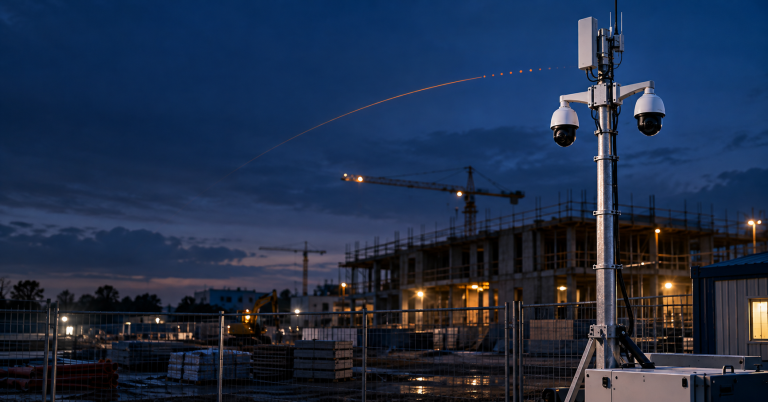
Two o’clock at night. Someone climbs over the fence of a construction site. The camera unit detects movement, starts recording and sends clips to the monitoring centre. At that exact moment, the SIM card reaches its data limit. Speed drops so far that the footage stutters, arrives in poor quality or does not arrive at all.
That is called throttling: the operator reduces the data speed as soon as a SIM card hits a set limit. The connection stays up, but it is too slow for video. For temporary CCTV, that is a direct security risk, because the limit is reached precisely during an incident.
In short
- A throttled SIM card stays online, but you can no longer send footage with it.
- A break-in causes the biggest data spike, so the limit hits at the worst possible moment.
- You only notice throttling when reviewing footage or through a support ticket, unless you track usage per SIM card.
- With pooled data or pay per MB without throttling, you do not have this problem.
What is throttling on a camera network without a fixed internet connection?
Many plans come with a fixed data bundle per SIM card. Go over it, and the operator drops the speed to a fraction of its normal level. The SIM card stays connected, and a status message or a small sensor reading still gets through. Live video and video clips do not.
Be careful with plans sold as unlimited, too. The terms often include a fair use limit, and above it the speed still goes down. Are your camera units running on a plan like that? Read those terms before an incident shows you what is in them.
Why does throttling hit temporary CCTV harder than other IoT applications?
A smart meter sends a few kilobytes a day. Nobody notices if that connection is a bit slower. A mobile camera unit sends video and uses tens of gigabytes a month, and that usage varies widely per location. A unit on a busy construction site with a lot of movement uses many times more than a unit at a quiet, empty building.
A fixed bundle per SIM card is a poor fit for that. On one unit half the bundle goes unused, while another runs into its limit halfway through the month. And because units are unmanned and move every few weeks, there is nobody on site to see the footage coming in slower.
Why does throttling happen precisely during an incident?
A camera proves its value the moment something happens. A break-in triggers continuous recording, followed by a series of motion clips. You will not get more data in less time.
If the SIM card is already close to its limit, it crosses it during the incident. The footage that should show what happened arrives late, in low resolution or not at all. The alert to the monitoring centre is delayed, while every minute counts.
How do you notice that a SIM card is being throttled?
In practice, in one of two ways: a customer reports through support that they are not getting any footage, or you find out when reviewing footage after an incident. Both are too late. Earlier signs are stuttering live video, clips arriving with a delay and a unit that worked well before and suddenly delivers poor footage.
Track usage per SIM card in real time and you will see a unit heading towards its limit before anything goes wrong. Set an alert at a threshold and you have time to adjust the bundle or check the unit.
Which plans prevent throttling on camera units?
The risk disappears when there is no longer a fixed limit per SIM card. Two models suit temporary CCTV.
With pooled data, all your units share one data bundle. If one unit has a spike, the spare capacity of the other units absorbs it, without those other units being affected.
With pay per MB, there is no bundle to run out. You pay for what you actually use, and a unit sitting in the yard between two jobs costs nothing.
If your units constantly use very large amounts of data, a fixed plan per gigabyte is hard to beat. If you run a rental fleet where usage per unit and per month fluctuates widely, pooled data or pay per MB is a better fit.
How do you prevent security system outages caused by throttling?
For most IoT applications, throttling is an inconvenience. For temporary CCTV, it is a gap in your security, because the limit hits at the moment you need the footage most.
Thingsdata does not apply throttling. You choose pooled data across all your units or pay per MB, and SIM cards in stock or on pause cost nothing. Our Activation Ready SIM cards work as soon as the unit is in place. In Thingsdata Control you see usage per SIM card, set alerts and activate or deactivate SIM cards yourself.
For each location we choose from multiple operators, with access to more than 650 networks. With the Extended SLA 24×7, we pick up a connectivity issue at night too. Thingsdata connects more than 1 million devices in over 180 countries and is ISO 9001 and ISO 27001 certified.
Want to know whether the SIM cards in your camera units are being throttled? Call us on +31 6 57 31 54 85 or email hakkert@thingsdata.com, and we will look at your usage together.

Need reliable IoT SIM cards? Request our test kit for 3 free SIMs with 100 MB data for 3 months. Experience seamless IoT connectivity today.
Looking for a reliable IoT partner? Download our brochure for instant access to valuable insights about our services and IoT solutions.