
Imagine: your security system sends an alarm in the middle of the night. The network is overloaded. The signal never arrives. Or your charging stations are full of waiting EV drivers, but payment processing is offline. Or a greenhouse full of crops receives incorrect climate settings because sensor data has not been coming in for two hours.
These are not hypothetical scenarios. This is what happens when IoT connectivity is treated as a given.
Connected devices are only as reliable as their connection
Organisations invest heavily in smart devices: sensors, cameras, charging stations, medical monitors, industrial controllers. Those devices only deliver value as long as they are connected. And that connection is vulnerable as long as you depend on a single mobile provider.
Mobile networks are reliable, but not infallible. An outage, planned maintenance, or a coverage gap is enough to take a device off the network. At that point, the device stops performing the task it was purchased for. Those costs rarely show up as a single, clear line item. They are hidden in missed alerts, manual interventions, dissatisfied customers, and reputational damage. And sometimes in direct liability.
One SIM, multiple networks: how it works in practice
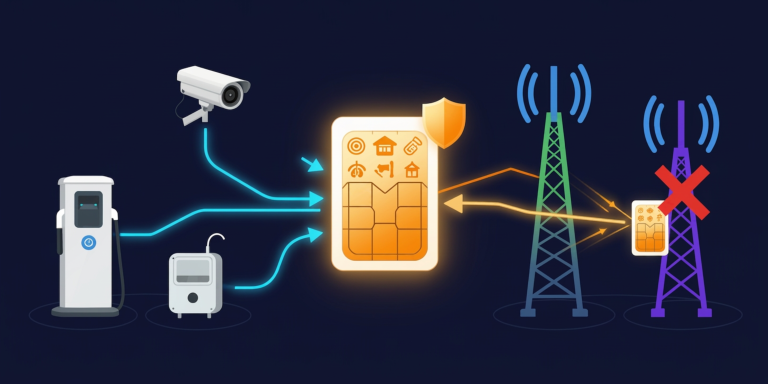
Thingsdata supplies M2M SIM cards that maintain a continuous connection across multiple independent networks. Not as a fallback solution activated after an outage is detected, but as standard operating procedure.
The SIM carries two active provider profiles, each with its own core network that is continuously available. If the primary network goes down, no switchover is needed. The second network is already active. The device notices nothing, your system notices nothing, and the data keeps flowing.
Because Thingsdata is not tied to a single network operator, the network that best suits your application and location is selected for each situation. No vendor lock-in, no compromises based on whatever happens to be available.
What this means in practice per market:
- Security and Access Systems
A security system does not get a second chance. A signal that does not arrive is a signal that does not exist. With multi-network connectivity, every device sends its data via whichever network is available at that moment: without delay and without dependence on a single provider. The same applies to smart access systems where real-time communication between device and backend must be guaranteed at all times. - Connected Healthcare
Wearable emergency buttons, monitoring equipment, and medical telemetry operate in environments where networks perform inconsistently — such as care homes, remote locations, and mobile situations. Connectivity that adapts to network availability is not an added value here, but a requirement. - Charging Stations
Charging stations are more than a power outlet. They process payments, communicate with backend systems, and supply data for grid management and billing. An offline charging station is unusable — for the end user and for the operator alike. Stable connectivity keeps the station operational and revenue on track. - Industrial IoT, Logistics and Fleet Management
Production processes, inventory management, and fleet monitoring are built on a continuous data stream. An interruption of just a few minutes can cause chain errors that take hours to resolve. M2M SIM cards with network-independent connectivity form the foundation of a reliable operation. - Smart Agriculture and Water Management
Sensors in greenhouses and in the field measure temperature, humidity, and soil conditions at locations where network coverage is inherently less predictable. The same applies to water management, where sensors at remote locations transmit leak detection, water levels, and quality measurements. Multi-roaming SIM cards ensure that data is reliably delivered even from remote plots of land.
Central management without the hassle
Reliable connectivity starts with the SIM, but does not stop there. Through the Thingsdata Portal, you manage all SIM cards centrally: real-time insight into data usage, SIM status per device, and direct control over your entire IoT connectivity. The SIM cards themselves are device-agnostic. They work in any compatible device from any manufacturer, and when hardware is replaced, connectivity simply continues.
The question is not whether you need connectivity — the question is how much downtime you can afford. For most organisations that invest seriously in IoT, the answer is: none. Thingsdata delivers the connectivity infrastructure that matches that answer.
Your SIM cards always under control, wherever your devices are
Thingsdata’s M2M SIM cards are designed to eliminate that risk. They roam on the strongest available network, are active in 190 countries across more than 650 networks, and support the full network spectrum from 2G through to 5G. There are no activation costs, no contract obligations, and no minimum order quantity. You pay for what you use and scale when needed: prepaid, postpaid, bundled, or pay-as-you-go, depending on your situation.
Want to find out which connectivity solution is right for your specific application? Thingsdata is happy to think along with you in concrete terms, from business case to implementation. Get in touch at +31-85-0443500 or email info@thingsdata.com.

Need reliable IoT SIM cards? Request our test kit for 3 free SIMs with 100 MB data for 3 months. Experience seamless IoT connectivity today.
Looking for a reliable IoT partner? Download our brochure for instant access to valuable insights about our services and IoT solutions.